KIS’M project
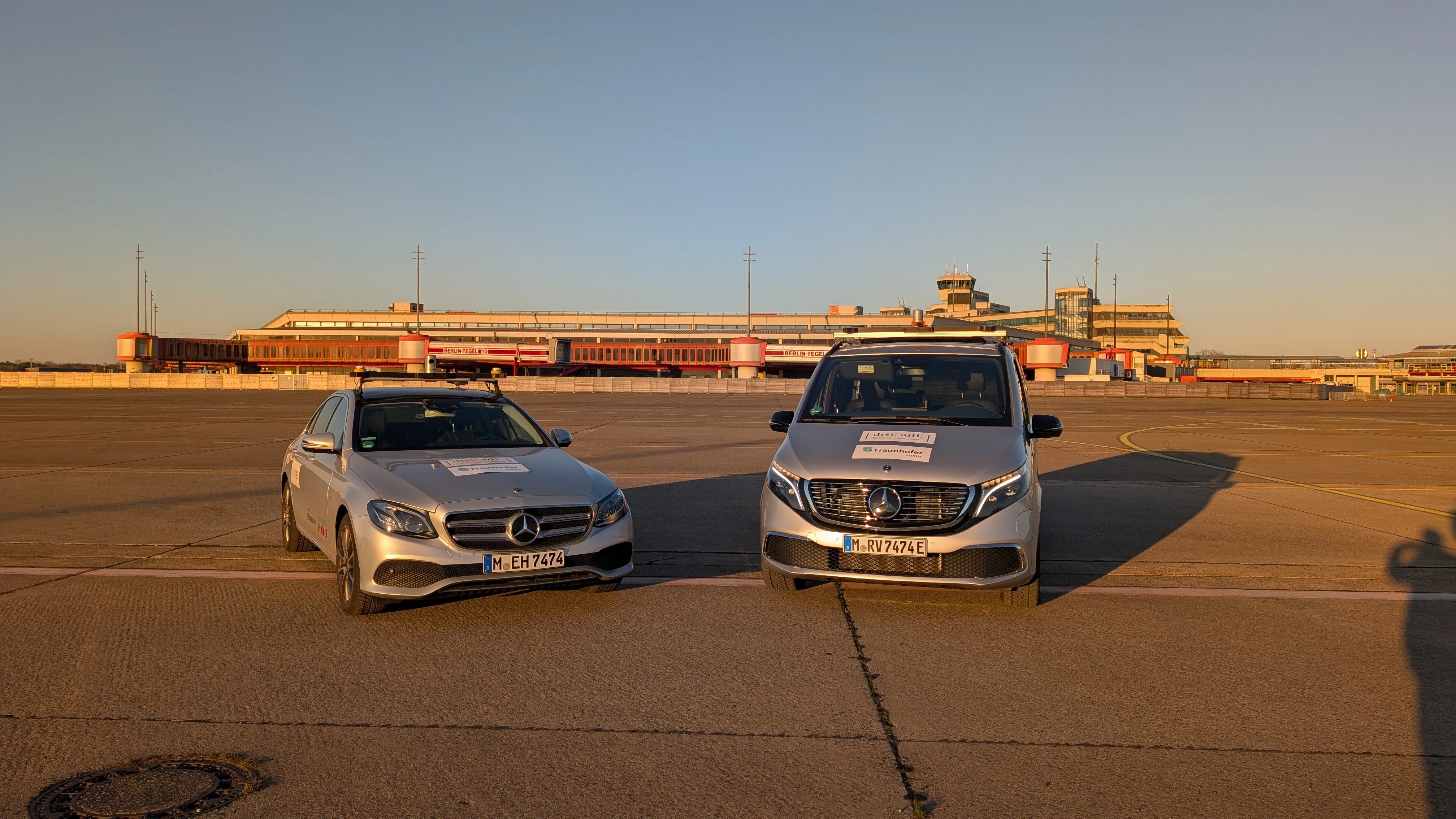
The KIS’M project (AI-based system for connected mobility) tested an AI-powered mobility system designed to address the challenges of autonomous, driverless, and on-demand operations in dynamically growing urban areas.
Trials were conducted at the Berlin TXL – Urban Tech Republic Innovation Campus
and later extended to adjacent public roads.
Autonomous shuttles transported passengers on demand, without attendants on
board, and stopping at virtual bus stops.
The project aimed to improve safety and efficiency in mixed traffic systems through better networking between vehicles and traffic management.
Digital Process Chain for Traffic-Regulating Data
As part of KIS’M, a digital process chain was established to capture and provide traffic-regulating data. Construction sites were derived from crowd/xFCD data, and traffic signs (physical implementation of traffic regulations according to § 45 StVO) were recognized using AI and provided through an automated process chain. The data was integrated into the Digital Platform for Urban Traffic (DPS) of the Berlin Senate Administration – an open mobility data platform with standardized interfaces, subject to the legal framework of the IVS Directive (2010/40/EU, (EU) 2023/2661). The data served the traffic editorial team as a prototype for validating the current state of traffic conditions and for verifying official data records (street furniture, traffic signs, construction sites). This directly contributed to the digitalization and data provision in the area of municipal traffic regulations.
The currently ongoing follow-up project DiKAS continues this work and deepens the connection to traffic regulations directly: a core component is a functionality for the automated comparison of the approved traffic regulations (AO) of the SenMVKU with captured real data (change detection). Identified discrepancies (e.g., construction site in the order but not on site) are provided via a web dashboard and defined interfaces (API), verified by the responsible control group, and fed back into the official specialist procedure (VMS-Haller). This addresses both the provision of data on traffic regulations and the digitized processes for ordering and executing traffic regulations in accordance with the IVS Directive.
The project was coordinated by the Berlin Senate Administration for the Environment, Mobility, Consumer and Climate Protection and implemented by leading research and industry partners. It was supported by the Federal Ministry for Digital and Transport (BMDV) with €9.53 million (2022–2025).
Project Details
- Title: KIS’M – AI-based system for connected mobility
- Coordination: State of Berlin, represented by the Senate Administration for Mobility, Traffic, Climate Protection, and Environment (SenMVKU)
- Duration: 01/2022 – 03/2025
- Budget FOKUS: 1,997 k€
- Funded by: Federal Ministry for Digital and Transport (BMDV)